
The BOOST page, running a simulated drive. In the car every number comes from the engine computer.
A gauge for the centre vent of the E60 and E90.
SPOOL sits in the centre air vent and shows what the engine computer knows: boost against its target, exhaust gas temperature, rail pressure, every temperature, the particulate filter. It asks the engine computer with the same request BMW's own diagnostic software uses.
For the E60 and E61 with the M57TU2 diesel, 2007 to 2010. Now also for the E90, E91, E92 and E93, with a vent pod of their own.
Values50
Pages10of 10
Screen2.8in
Price249EUR

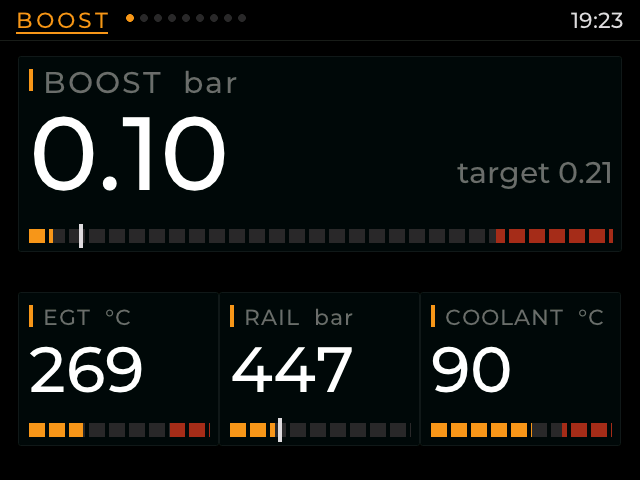
BOOST
1 / 10
BOOST
In the car the cruise-control stalk turns the pages: a short push up for the next, down for the previous. Two taps on the pod do the same. Here: the ▲ ▼ buttons, the up and down arrow keys, or a double click on the screen.
Captures read straight off the gauge's screen on the bench, with simulated values.
What it can show
Pressures
Boost and its target, manifold absolute, barometric, rail and its target, exhaust before the DPF.
Temperatures
Coolant, oil, exhaust gas, intake air, charge air, fuel, outside, gearbox oil.
Engine
Rpm, speed, accelerator, torque, injection quantity, air mass and its target, turbo vanes, EGR, swirl flaps, battery, gear: P, R, N, D1 to D6. Range and litres in the tank, from the instrument cluster.
DPF
Soot, distance since the last regeneration, pressure drop across the filter, regeneration statistics.
Injectors
Each cylinder's correction, as in BMW's own diagnostic software, where the engine computer works them out.
g
Longitudinal and lateral, from the DSC's own sensors. 0 to 100, 80 to 120 and 100 to 200 km/h time themselves.
Up to ten pages, nine layouts, every page editable from the phone. Bars carry a red zone, and boost, rail and air mass a mark at the engine computer's target. Pages are kept in the gauge and survive updates.

The settings menu is your phone.
There is no app. With the car standing still, hold the cruise stalk up or down for three seconds, or tap the pod three times. The gauge opens its own Wi-Fi and shows this card.
- Scan the code with the phone camera and join.
- Open 192.168.4.1 in the browser.
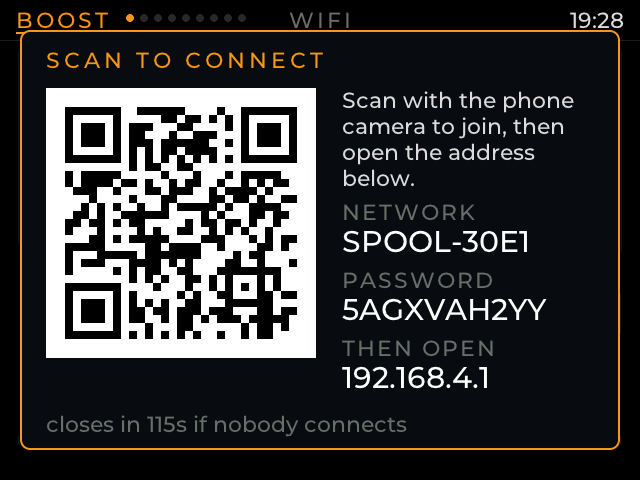
The Wi-Fi switches off after two minutes without a phone, after fifteen at most, and as soon as the car moves. The password is different on every gauge.
The real page, with sample data. Try it.
Pages
Your pages as a list, reordered with arrows. Open one and it is drawn as it sits on the screen; tap a box to pick its value.
Car
The engine computer's fault codes with BMW's descriptions, and every value live.
Settings
Brightness, theme, start page, auto-cycle, removed parts. Saved as you change them.
Gauge
Updates, workshop mode, the factory pages, the support report.
Fault codes
The gauge reads the engine computer's fault memory and says, for each fault, whether it is present now, stored, or would light a warning lamp. It can clear it too: only the engine computer's, only standing still, and only after you confirm. Then it reads the list again, so a fault that is still there shows again.
New software over Wi-Fi.
An update is one file. Put it on your phone, open the gauge's page and install it. Nothing comes apart and no cable is needed. Your pages and settings stay.

Nothing is cut.
The gauge connects to the powertrain bus (PT-CAN) at the body gateway behind the passenger footwell trim, and takes its power from the centre-console switch block. Ready-made looms go in between: the car's own wires are unpinned from the connector and clicked into the loom, and the loom goes into their place. It all comes out again.
On the E90, E91, E92 and E93 the bus and the power are both taken at the junction box behind the passenger footwell trim, the same way.
The OBD port stays free for workshop tools. We can fit it for you, EUR 50 to 80.
Which cars.
E60 and E61 with the M57TU2 diesel and the DDE 6.2 engine computer, 2007 to 2010. Tested on a 2007 E61 530d xDrive.
E90, E91, E92 and E93: a vent pod of their own for the left side of the centre vent. It clips in left side first, then the right side rests in. Ask first which engine.
For any other car, ask first.

Built not to disturb the car.
The gauge shares a bus with the engine and the brakes. It is built on that basis:
Starts silent
The hardware holds the transmitter off until the software deliberately enables it.
Listens first
It only sends while the car's own traffic is on the bus, so it never wakes a sleeping car, and only after three seconds without an error.
Stops at the first error
One bus error while sending switches transmission off within a millisecond.
Asks gently
One request at a time, ten a second at most. It only reads, with one exception: clearing the engine's faults, when you ask.
Steps aside
If another diagnostic tool talks, it goes quiet by itself. For coding there is a workshop mode: it asks nothing and says WORKSHOP on the screen until you switch it off.
Price.
Package249EUR
The gauge, the 3D-printed vent pod and the plug-in looms.
First 5 to 10 buyers199EUR
In return for feedback and drive logs.
Fitting50to 80 EUR
If you would rather we fit it.
Built in small numbers.
Phone+359 885 558 552
E-mailspoolgauges@gmail.com


Questions.
Will it drain the battery?
On the E60 and E61 it runs from a supply the car itself switches off 30 to 60 minutes after the ignition. Until then the screen is dark but the gauge draws a small current. Sleeping fully with the car is coming in an update.
Can it harm the car?
It is built around exactly that. See the five rules.
Do I need an app?
No. The phone's browser and the gauge's own Wi-Fi. No internet needed.
My DPF or EGR has been removed.
Switch them off on the phone. The gauge stops asking for their values and hides the pages built from them.
Can I still plug in a diagnostic tool?
Yes. The OBD port stays free, and the gauge goes quiet by itself when another tool talks. For coding, switch on workshop mode.
Can it clear fault codes?
Only the engine computer's, standing still, after you confirm.
Can I take it out when I sell the car?
Yes. Nothing was cut: the looms come out and the car's own wires go back where they were.
Is it a touch screen?
No. The stalk, two taps on the pod, and your phone.